
Dante Wrote Hell, Botticelli Drew It, Maslow Classified It; We Keep Digging…

I. THE FIRST DRAFT OF HELL
Human beings invented hell. However personal, scattered, or resistant to words the darkness may be,
to describe it, people first needed a place, then a story of what happened to them there.
Unstructured fear merely overwhelms; mapped fear gives rise to thought. People recoil from the unknown,
yet carry an organized terror for longer. When Dante Alighieri wrote the Divine Comedy between 1308 and 1320,
he was doing more than producing a text about religious dread. He was drawing up an architectural plan
showing how people build their own inner collapse, step by step. His hell is no fairy-tale backdrop. It is a system:
a closed system in which every act produces its own consequences, every tendency prepares its own end,
and every person gradually settles inside their own choices. Cold and merciless. The Middle Ages sometimes spoke more honestly than we do today.
That was precisely the point.
Dante’s true genius lies in constructing hell not as a fiery theater of terror, but as a moral and psychological logic.
Punishment there is not violence imposed from outside; it is the consequence that grows from the act itself. Lust
is more than bodily excess: it is desire that has lost its bearings, endlessly swept off course. Gluttony is more than
eating too much: it is the collapse of proportion, the sense of “enough,” the understanding of limits. Avarice fixes value in the wrong place.
Prodigality consents to letting value slip away. Betrayal is more than a moral offense:
it is a cold-blooded way of severing warmth, intimacy, trust, and connection. In Dante’s hell, then, no one
is punished at random. Sooner or later, everyone comes to inhabit what they have done. That is the point: whatever you do,
you end up living inside it. The more sanitized language we use today does not make it any less brutal;
it only makes us imagine we are more civilized.
But words have limits. Thought persuades; an image seizes us. Sometimes we are shaken not by what we understand,
but by what we see. At some point, the inner architecture Dante built with words had to become visible.
This is where Sandro Botticelli enters. With the Renaissance’s elegant, brilliant, faintly insolent aesthetic intelligence, he draws La Mappa
dell’Inferno and does more than depict hell: he lays it before our eyes. Hell is now something seen,
not merely told. That spiral, narrowing downward, collapsing inward, compressing layer upon layer, is more than a picture:
it is the mechanics of a fall. Botticelli is not Dante’s assistant here, but his accomplice. Dante creates the language of the descent;
Botticelli creates its image. One forces us to think; the other, to confront.
What makes this drawing great is not merely its detail, but the way that detail is organized. As each circle opens into the next,
space narrows, pressure rises, and density deepens. The dark funnel resembles a visual diagram
of how human behavior collapses inward when misdirected. It is almost an MRI scan, rendered in lines, of conscience, desire, will, and hunger
in their corrupted forms. That is why Botticelli’s lines do more than please the eye: they diagnose.
Here, too, lies the Renaissance’s great trick: presenting horror through beauty. Looking at the drawing,
we are both enchanted and disturbed. We take the blow, then admire the brushstrokes. Part of the history of making violence, decay,
and distortion easier to swallow through aesthetic packaging begins here. It looks like an ancestor of what we do today with filters,
sanitized language, corporate presentations, and disasters polished under flattering light. When horror is served in a well-composed frame,
it is suddenly mistaken for “content.” That, after all, is the modern age’s greatest trick:
turning decay into a visual discipline.
The reason we still imagine hell this way is not simply Dante’s words; to a large extent,
it is Botticelli’s lines. A text demands abstraction; a drawing attacks directly. If we still imagine a fall
as a layered structure that narrows, collapses inward, and becomes more constricted the deeper we descend, that is partly
because Botticelli left us more than a frightening picture: he left us a topography of the mind. Hell thus
ceases to be a theological legend and becomes the inevitable consequence of human behavior—or, more precisely,
that consequence made visible. From that moment, it is no longer a place we go after death.
It becomes a way of living already being created by lives built on faulty foundations, postponed needs, distorted desires,
and decaying defense mechanisms.
At this point, a third name joins the table: Abraham Maslow. At first glance, it is an odd gathering: a medieval
poet, a Renaissance painter, a modern psychologist. Look closer, though, and they resemble different pages of the same file.
Dante establishes the moral and psychological logic of the fall. Botticelli draws its visual map. Maslow, meanwhile,
classifies the foundations of need that people require if they are not to fall, unravel, or gnaw away at themselves
from within. One describes the pit, another draws it, and the third says, “To avoid falling in, you must keep the ground beneath you
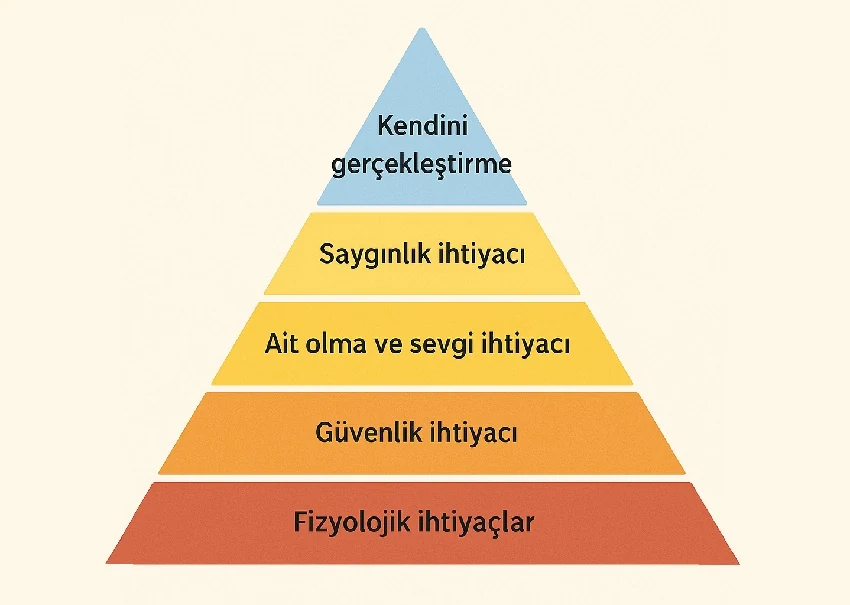
secure.” Maslow’s pyramid expands upward through physiological needs, safety, belonging,
esteem, and self-actualization. It offers hope and the idea of ascent. It suggests that being human is a process
we can organize. Dante’s pit, meanwhile, says something far more ruthless: without a foundation, you are already
falling.
This essay proceeds by reading these two structures together. To read hell solely as a religious allegory
is incomplete; to reduce it to psychology alone is equally thin. Here, we consider Dante’s architecture of hell
and Botticelli’s visual order alongside Maslow’s hierarchy of needs. In other words,
we are trying to understand which darkness people are cast into when a particular need decays; which deprivation produces which inner collapse;
and which form of psychological hunger finds its counterpart in which circle of hell. A little psychology,
a little sociology, a little art history—but above all, this uncomfortable truth: modern people often believe they are rising
while undermining the ground beneath themselves. As Maslow expands upward, Dante constricts downward. One
plays the melody of hope; the other keeps the rhythm of reality. The modern individual is a metronome swinging between these two sounds.
Believing they are climbing, they push the ground farther down. Thinking they are writing their own success story, they build the walls
of their own well. Dante drew hell’s first draft; Botticelli made it visible. The latest update, however, is being made
by modern human beings themselves.
II. HELL IN REVERSE: BELIEVING WE ARE CLIMBING THE PYRAMID, WE ARE ACTUALLY DESCENDING
DEEPER INTO DANTE’S WELL
Calling Dante’s hell simply “nine circles” is like explaining a great novel through its back-cover blurb.
It is technically correct, but comically incomplete. This hell is no flat list:
it is a meticulous system that branches, deepens, and distinguishes behavior not only by categories of sin, but by its psychological shades.
Dante does not behave like a crude morality policeman here; he works almost like an anatomist.
He observes the impulses, fears, hungers, denials, excesses, deprivations, shame, pride, resentment, and decay
that pass through a person, then translates them into a spatial order.
Each circle reveals more than what is wrong: it shows how wrongness is lived, how it feels, and how, over time, it becomes character. Understanding the circles of hell therefore means more than answering “who ended up where.” It means understanding how the lack within us—unmet needs, desire that has lost its direction, and distorted defense mechanisms—comes to be worn like destiny.

The first circle is Limbo. Most people imagine flames, screams, and dark stone walls when they think of hell;
Dante does not strike his first blow there. He is subtler. In Limbo, punishment is not noisy; it takes the form of absence. Here a person neither
burns nor finds deliverance, but remains suspended, as if waiting forever on a threshold. Neither fully inside nor fully
outside. Neither destroyed nor truly alive. That is what makes Limbo so tragic:
people are not even granted intense suffering; it is as though their right to fulfillment has been withdrawn. Those who cannot begin, who endlessly
postpone, who consign their potential to the future, who spend their lives in a waiting room saying, “Once things get a little better…”
already know this circle well. Modern life is extraordinarily successful at manufacturing Limbo.
We wake up, rush somewhere, come home, eat, sleep, and repeat; yet life itself often never
comes our way. From Maslow’s perspective, physiological needs are decisive here. People who cannot sleep regularly or
truly rest, whose bodies remain on alert even when their stomachs are full, who have a house but no sense of home, need
first to make contact with life, rather than pursue self-actualization. This is one of the modern age’s most disgraceful tricks:
shouting “Unlock your potential” at people whose nervous systems are exhausted, whose bodies are on alert, who are insecure, sleepless, and scattered.
Limbo is precisely this disgraceful contemporary comedy: mistaking survival for living.
The second circle is lust, but confining it to sexuality does Dante a disservice. What matters here
is desire that has lost its direction. There is wanting, but no axis. Passion, but no supporting pillar. People
think they are in love, yet often they are simply being swept about. That is why the punishment in the second circle is not fire,
but a storm. Desire no longer has a center of its own; it flings people from one place to another. In contemporary terms,
when a sense of safety collapses, passion creates dependency rather than connection. The safety level of Maslow’s pyramid
comes into play here. Someone who feels unsafe wants something to cling to more than someone to love. A person with anxious
attachment is often trying not to fall rather than simply falling in love. A person with avoidant attachment may say one day,
“I cannot live without them,” then flee the next, saying, “I am suffocating.” They approach, then run. Run, then return.
They mistake all this turbulence for depth. Attachment styles work like weather: anxious thunder, avoidant
dry winds, passionate hurricanes. But the wind teaches nothing; it only tosses us about. Mistaking that turbulence for freedom
is one of humanity’s oldest clichés.
The third circle is gluttony. And no, it is not merely about the stomach. Dante punishes not hunger, but excess.
People are so mired in mud that they can no longer distinguish what they truly need. That is why
mud is the perfect image: in mud, everything blurs together. Taste disappears, boundaries disappear, the sense of enough
disappears. Modern hunger often grows not in the stomach, but in the desire to be seen. Attention, approval,
visibility, likes, notifications, engagement, messages, content, consumption, production… All are temporary compensations
piled over a void that cannot be filled. If a person is truly seen, why must they market themselves anew every morning?
If a person is truly loved, why must they prove their existence every day? Because
the modern individual’s sense of lack is not easily satisfied. More precisely, they no longer believe it can be.
For Maslow, the need and hunger for belonging are at work here alongside physiological needs and safety. When people
do not feel secure within themselves, they cannot say “enough.” To say enough, you must first believe that you will not be left wanting.
The modern individual is so certain of future scarcity that they have learned to stockpile and hoard rather than feel satisfied:
in emotions, in relationships, on screens. People no longer merely consume; they offer themselves up for consumption. Gluttony here means both
devouring and consenting to be devoured.
The fourth circle holds the avaricious and the prodigal. This is one of Dante’s most ingenious mirrors. The two types facing
one another are not truly opposites, but two costumes worn by the same distortion. One hoards the self;
the other spends it. Neither understands value. Today, reading this circle in terms of money is not enough; we must read it through the self.
Some people hold on to love, attention, effort, and trust so tightly that giving even a little feels like a loss of their very being.
Others do the opposite, scattering themselves ruthlessly, piece by piece, among everyone, everything, every relationship, every platform.
One is drought; the other, flood. What they share is the erosion of self-worth. The esteem level of Maslow’s
pyramid fractures here. Unable to make genuine contact with their own worth, people either make themselves
inaccessible or offer themselves for unlimited use. Filtered faces, calibrated intimacies, lives made to look professional…
People know that what they display is not quite who they are. They also know they lack the courage to show
their real selves. Sometimes self-respect dissolves in precisely this double awareness: in hiding and in displaying. This is the modern world’s
great paradox: wanting to be seen while fearing it at the same time.
The fifth circle is wrath. But Dante looks not only at those who shout; he also looks at those who quietly rot. Often,
they are the more frightening ones. Anger expressed openly may be crude, ugly, and visible;
repressed anger seeps into character. A person may say, “There is no problem,” while their body tells another story.
They smile with a clenched jaw. They fall silent, but each silence leaves poison behind. In Maslow’s pyramid, the need for belonging and love
is violently fractured here. When people are not seen or recognized, when they do not feel loved in a way that is safe,
anger ceases to be a reaction and becomes a climate. Like a low-pressure system of rage, it spreads
everywhere. Whom are they angry with? Everyone. What are they angry at? Everything. With whom most of all? Often themselves. The modern individual’s
passive aggression, their hurt disguised as coolness, their enormous wounds walking around saying “I do not care,” bring the fifth circle
into the present. Sometimes hell does not shout. It sulks. It creates distance. It takes refuge in humor. It camouflages itself with irony.
Then it calls this maturity.
The sixth circle is denial, one of the most insidious places of all. The issue here is not being mistaken, but knowingly rejecting
what does not suit us. Bending the truth, dismissing depth, treating meaning as unnecessary and thought as a burden…
Modern nihilism no longer arrives with grand pronouncements. It comes weary, ordinary, and everyday:
“Never mind.” “No need to make such a big deal of it.” It begins with “Nothing is ever quite right anyway,”
then slowly hollows people out. That is the dangerous point. In Maslow’s terms, the levels of esteem and self-actualization
decay here, because people lose the appetite to invest in themselves, to grow, to deepen.
Life is switched to autopilot. Not thinking is presented as a personality trait. Shallowness is mistaken for freedom. People erecting their own inner
gravestones often market the process as “being easygoing.” That is the tragedy. The problem is not that people
are unhappy; it is that they have not visited themselves in a very long time.
The seventh circle is violence. Dante distinguishes violence against oneself, others, and nature. That distinction remains
uncomfortably relevant today. Violence is more than shouting, hitting, and breaking things. Living with an inner voice that treats you as an enemy
is violence too. Constantly belittling yourself, neglecting your body, turning your soul into a performance machine:
these are forms of violence. So are manipulating, devaluing, or emotionally exploiting another person.
So is treating the world, the city, and our shared life with careless brutality. Modern life has refined violence, not eliminated it.
Burnout is marketed as success; self-erasure is applauded as discipline; emotional abuse is given an aesthetic gloss
as a “complicated relationship.” Here, Maslow’s pyramid begins to fail, because people are no longer
meeting their needs; they are eroding their own foundations. Undermining oneself ceases to be a metaphor:
it becomes a habit, then a character trait. That is what is most frightening:
mistaking the harm we do to ourselves for strength, resilience, or maturity.
The eighth circle belongs to the fraudulent. Dante constructs a realm that feels like a spoiler for the modern world, delivered centuries
in advance. Ten ditches hold ten forms of manipulation: seducers, flatterers,
false prophets, corrupt officials, hypocrites, thieves, sowers of discord, falsifiers… This variety reveals a simple but painful
truth: collapse often comes not through crude evil, but through sophisticated deceit. Fraud
is no longer the exception; it has become the system’s language. What matters now is less truth itself than what looks convincing, comes well packaged,
persuades, and can be sold. Even authenticity becomes a marketing story. People no longer
realize themselves; they display themselves. Worse still, they reduce themselves to the parts that can be displayed. Not the whole soul,
but the fragment that looks good in the shop window is put into circulation. In time, the mask replaces the face. Eventually, even pausing to ask “Who am I?”
seems like too much effort. Self-actualization, the highest level of Maslow’s pyramid, becomes a caricature
here. Self-actualization is a long, painful, inward, and often quiet process. Self-display,
by contrast, is quick, rewarded, and applauded. And the modern world prefers applause to transformation. Today the eighth
circle speaks the language of advertising, teaches personal branding, offers aesthetic consulting, and probably
has a LinkedIn account. Most dangerous of all, people here do more than deceive others: eventually,
they stop believing in their own image as well.
The ninth circle is betrayal. Dante’s choice of ice rather than fire is no accident: betrayal is not a heated outburst,
but a cold decision. Not a flash of anger, but a deliberate withdrawal. It severs bonds, kills trust, and slowly freezes
what is alive. In the modern age, betrayal is not confined to what we do to others:
people betray themselves, their time, their desires, their potential, even their own bodies. They silence
their truth, diminish their voice, endlessly postpone their lives, then call it maturity, patience, or
reason. What is happening is often much starker: people quietly withdraw from their own lives. They sit on the shelf like a frozen
package—present but without warmth, moving but not alive. This is precisely where the summit of Maslow’s
pyramid turns upside down. In a life without foundations, self-actualization becomes estrangement from the self.
From the outside, someone may have countless roles, titles, identities, and routines; inside, however,
gradually, no one remains. Most frightening of all is the point at which even pain can no longer be fully felt.
Beyond a certain point, it is not only the heart that freezes, but pain itself. This is one of modernity’s quietest disasters:
slowly withdrawing from your own life and mistaking that withdrawal for functioning…
At the end of all these circles, modern people must confront the same truth, whether they want to or not:
Dante’s hell is less theological than we imagine, and far more psychological than we think.
Botticelli made this system visible; Maslow, reading it in the opposite direction, classified the needs
that keep people from falling apart. One constructs the architecture of the descent, another maps it, and the third shows
how to preserve the ground beneath us so that we do not tumble in. This is precisely where our age’s real tragedy
begins. We are no longer strangers to the darkness. We have some idea of what is missing; we sense what is eating away at us
from within; we are not entirely unaware of which void we are trying to fill with what. Yet
we keep the collapse going. We scroll again, cling to the wrong lives again, confuse need with desire,
love with clinging, growth with performance, again and again. The modern tragedy is not that we do not know hell;
it is that, knowing it, we make room for it in our daily lives.
That is why the issue was never simply getting out. First, we had to see where we had descended. The most dangerous
thing about hell is not its fire; fire at least sounds an alarm. The real danger is mistaking it for scenery,
for the norm, for the ordinary ground of life. It is mistaking our own decay for character,
our exhaustion for maturity, our disintegration for busyness. Beyond a certain point, we do more than become accustomed to pain:
we rename it. We call deprivation discipline, burnout success, emotional deprivation
selectiveness, and estrangement from ourselves functionality. This is where catastrophe begins: hell ceases to be something we fear
and becomes a lifestyle we believe we can manage.
Perhaps this is the modern age’s most sophisticated hell: decorating our own pit with the packaging of comfort, success, visibility, and
busyness, then calling it life. Dante’s terror is still very much alive; it has merely changed costume.
Botticelli’s funnel is still before us; we now look at it on a screen rather than on a wall.
Maslow’s pyramid is still there too, but instead of climbing it, we often dig away at its foundations. Perhaps
it all comes down, in the end, to being this honest: sometimes people do not fall into hell. They slowly make it
habitable.
Author: Ebru Karaca
Art historian, Aktif Sanat writer and moderator
Source: MYART, the art magazine published by Myrine Yayınları. Read it here: https://www.myrinayayinlari.com.tr/
Comments
To write a review Log in.