
Guernica: Art at Its Most Confrontational
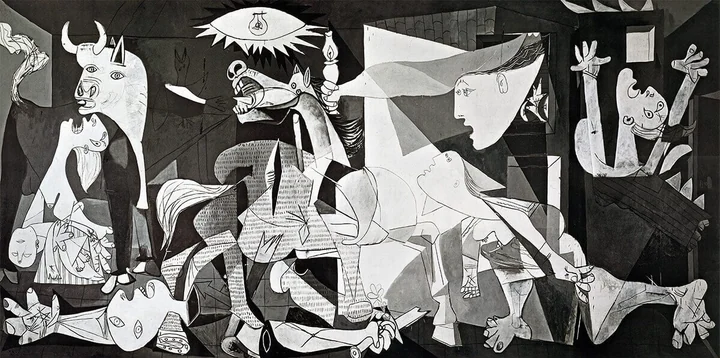
Looking at humanity’s complicity through a painting.
Picasso.
Even saying his name makes art history a little uneasy. He did more than paint: he broke the world apart, then laid the pieces before us. Born in Málaga in 1881, he picked up a brush as a child, prompting his teachers to say, “This boy is cursed: he sees too much.” They were right. Picasso refused to see things from a single angle. “This thing we call reality,” he said, “is not simple enough to be viewed through just one eye.” That was how Cubism was born.
But form was not his only concern. He picked fights with politics, too. He hated Franco, spat at the shadow of the Nazis, and dragged art out of its sterile realm of pleasure. His reply to those muttering “art for art’s sake” was simple: “No, my friend. Art is a megaphone. It amplifies the scream.” And amplify it he did. His private life was a mess: passionate, hurtful, narcissistic, full of women, and astonishingly productive. Picasso was a bundle of contradictions. Perhaps that is precisely why he expressed humanity’s contradictions so clearly.
In 1937, the small town of Guernica was bombed. With Franco’s cooperation, Nazi aircraft rained death from the sky. Women, children, older people, people buying bread in the marketplace… The comforting fiction that war was “confined to soldiers” collapsed for good. Picasso heard the news in Paris. He was beside himself. He attacked the canvas. He chose black and white because color would have been too much for this story. Color would have made suffering aesthetically pleasing; Picasso wanted a slap in the face, not an aesthetic experience…
But Guernica’s story did not end on the canvas. The painting itself went into exile. When the fair closed, the Republicans took it with them, carrying it to Scandinavia and England. “Look,” they said. “Our town burned. Do not look away.” Awareness, funds, conscience… But in 1939, the Republic fell. Franco won. Picasso set one condition: “This painting must return to a free Spain. Not before democracy does.” Suddenly, Guernica had become a political refugee.
Fearing Nazi occupation, Picasso sent the painting to New York. It hung on the walls of MoMA, the Museum of Modern Art, but it was less an exhibition piece than a conscience in exile. For twenty years it traveled through America and Europe, provoking debate wherever it went. It did not return during Picasso’s lifetime; he died in 1973 without seeing it come home. In 1981, with Franco consigned to history, Guernica finally returned to Madrid. It was first housed in the Casón del Buen Retiro, then moved to the Reina Sofía in 1992. Even that move was controversial: Picasso had wanted the painting to stand among the masterpieces of the Prado. The state had other ideas. Like the war it depicts, Guernica’s journey was always shaped by political decisions. The painting did not merely portray war; it became an actor in postwar politics…
Now let us return to the painting. At first, Guernica shows you chaos. A horse screams; a woman has lost the child in her arms; another woman reaches toward the sky; a huge eye within a lamp gazes indifferently at humanity. And the bull. Yes, that upright, impassive bull. Some see Franco in it. I see us. The spectators, standing there, looking. At the town in 1937; at our screens today. “How terrible,” we say, then pick up the remote and change the channel. Once we looked at the painting; now we look at thirty-second videos on social media. The only thing that has changed is the image quality! The bull is a portrait of our gaze…
Cubism here is no playful exercise in breaking up forms; it is the necessary logic of the story. This horror cannot be told from a single angle. A mother’s scream, a horse’s cry, God’s silence, the face of fascism… They all exist at once. That is why the bodies are fragmented: society is fragmented. Hand torn from arm, face from body, life from the news bulletin. There is no single figure, no single story; memory is piled upon memory. We are all fragments, all incomplete, all unfinished! Guernica is more than a moment: it is the trauma of an entire age…
And yes, this painting is not beautiful. It has no wish to be. While Franco sold “glory” to the sound of victory marches, Picasso sold “shame” through a scream. Guernica had to disturb, not delight. Discomfort wakes us from sleep. So when you stand before it, you want to look away, but cannot. The painting looks back. It even whispers: “Really? A backdrop again?” Meanwhile, we line up to take selfies in front of it! That is exactly where the slap lands. Guernica is no selfie backdrop; it is a stone in the pit of your stomach.
We call Guernica “disturbing” and invest it with a kind of sacred status. But how long does the discomfort last? An hour? A day? Then we go home, eat, make love, sleep. What, then, is art’s social function? Perhaps it scratches at our conscience for a moment. Guernica slaps us, and we stroke our cheek: “Thank you, Picasso. That was beautiful.”
That is precisely art’s social function. A work does not simply hang on a wall: it circulates, changes place, changes its viewers. As Guernica traveled from Paris to America and back to Madrid, it did more than change locations; its meanings multiplied. Art builds society’s memory. Guernica became that memory’s black box. But human beings seem made to forget…
Consider the present. War is no longer experienced only on the front line; it happens on screens. Bombs fall through phone notifications; dead children pass through our timelines. And what do we do? The more we see, the less we feel. Empathy dies of an overdose. Social psychology calls this “normalization”; I call it “humanity on autopilot.” To survive, people learn to turn down their hearts. But society’s nervous system becomes paralyzed.
At the cultural level, the question grows harsher: whose suffering is seen, and whose remains invisible? Which death counts as a “loss,” and which as “collateral damage”? This is where Guernica’s universality lies: its anonymous screams expose the disgrace of selective compassion. You cannot label these figures with a nationality, a religion, or an ideology; try, and the painting pushes back. It rejects all the labeling games played in humanity’s name.
And when philosophy enters the picture, the slap grows harder still. The true weapon of war is not the bomb. It is the spectator’s silence. Silence shakes hands with the person who drops the bomb. Silence comforts itself by saying, “It did not happen to me.” Silence is an accomplice. That is precisely why Guernica still disturbs us. It does not tell us that “war is bad.” It says something worse: “You are still standing amid the evil, watching like the bull.”
When we step away from Guernica and into the present, we recognize something simple: we no longer hear screams; we hear notification sounds. A death lasts as long as a photograph, then new content arrives. We look without seeing. Even when we see, we forget. We learn to forget because remembering is a burden. Then we call that forgetting “normalization”—giving our complicity a new name to soothe our conscience.
Standing before Guernica, we may think of the cliché “geography is destiny.” But Picasso’s painting says something else: geography is more than destiny; it is politics itself. Who sends up the aircraft, who finds shelter, whose death becomes news, whose death is forgotten…
All of it is political. The issue is not the land, but the decisions. And here is the final point: Geography is not destiny; it is a question of who decides. Guernica throws that truth in our faces.
Because Guernica is not a painting, but a gravestone.
Its inscription, carved in black and white, reads: “Here lies humanity.”
Author: Ebru Karaca
Art historian, Aktif Sanat writer and moderator
Source: MYART, the art magazine published by Myrine Yayınları. Read it here: https://www.myrinayayinlari.com.tr/
Comments
To write a review Log in.